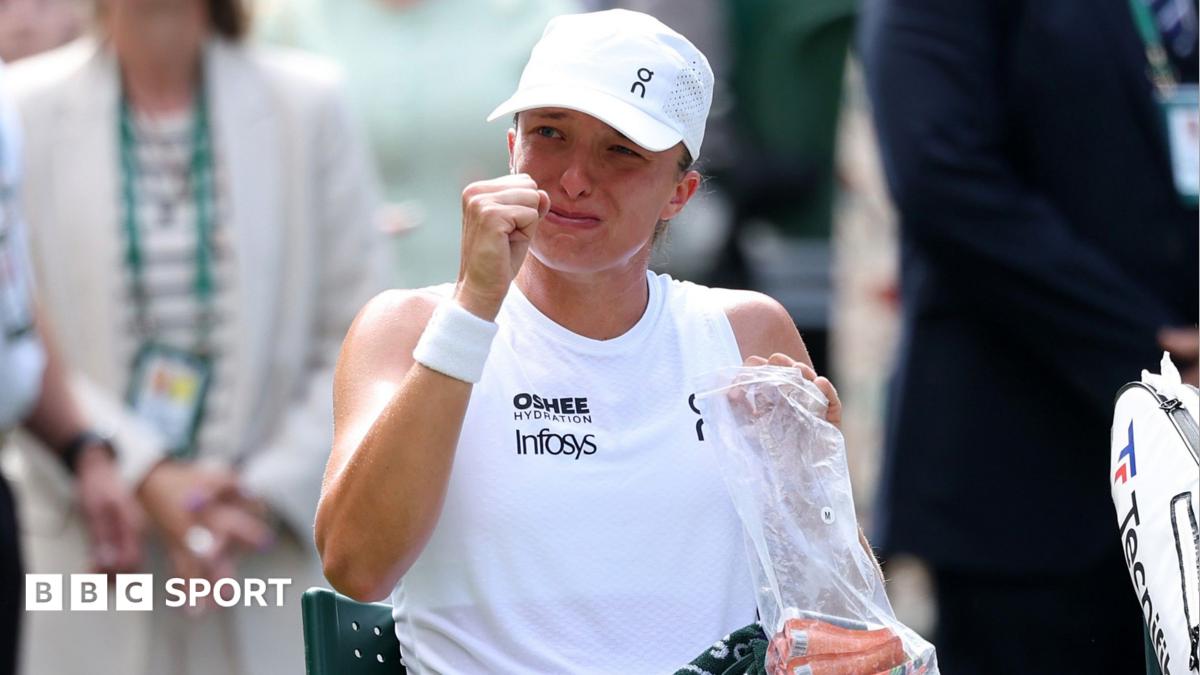
Iga Swiatek’s Wimbledon title defence began with relief rather than authority, as the world’s leading grass-court storyline was immediately tested by Taylor Townsend in a tense first-round match. The Polish star eventually came through in three sets, but the emotional reaction at the end told its own story: this was not a routine opening day for the defending champion.
For Swiatek, the result matters as much for what it prevents as for what it confirms. Early exits at major tournaments can quickly alter the mood around a title defence, especially at Wimbledon where the surface punishes hesitation and rewards players who can reset after losing momentum. A scrappy opening-round win can sometimes be more valuable than a polished one, because it keeps the draw intact while exposing the pressure points that still need managing.
A difficult start, but a crucial escape
The BBC report described the victory as a stuttering one, and that framing is important. Swiatek did not cruise through the match, and the fact she was tearful afterwards suggests the emotional load around the occasion was significant. Defending a Wimbledon crown brings a different kind of scrutiny: every set is judged against expectation, and every wobble invites questions about form, confidence and adaptation to grass.
Townsend’s role in the match should not be overlooked either. First-round opponents at Wimbledon can be dangerous precisely because they arrive with little to lose and a clear tactical plan. Against a top seed, that often means taking risks early, extending rallies when possible and forcing the favourite to solve problems before rhythm has been established. Swiatek’s ability to survive that test is a positive sign, even if the performance itself leaves room for improvement.
What it means for the rest of the tournament
For supporters, the immediate takeaway is simple: the title defence is still alive. But the longer-term reading is more nuanced. Swiatek’s path through Wimbledon will likely depend on how quickly she turns this kind of pressure into control. On grass, that usually means sharper serving patterns, cleaner first-strike tennis and a willingness to shorten points before opponents can settle.
There is also a broader context here. The source notes that Swiatek has had a tough couple of weeks, which adds weight to the emotional release after the win. In that sense, the match may serve as a reset point. A difficult opener can either drain a player or sharpen her focus; for a champion, the challenge is to make it the latter.
Swiatek now moves on with the most important box ticked: survival. The performance was uneven, but Wimbledon often rewards players who can absorb an early scare and keep moving. If she can build from here, this first-round struggle may be remembered less as a warning sign and more as the moment her defence found its footing.
Source note: This article was prepared using publicly available information from BBC Sport and expanded with editorial context.
Share this content: